Case Report
PubMed: an untapped source for open educational resource images
Ellie Svoboda, MLIS1, Teresa Connolly, PhD, RN, ACNS-BC2
doi: http://dx.doi.org/10.5195/jmla.2026.2210
Volume 114, Number 2: 159-163
Received 04 2025;
Accepted 11 2025
ABSTRACT
Background:
Open Educational Resources (OER) are free learning materials that benefit students
in higher education, including in the health sciences. As more health sciences OER
materials are created, there is a need for openly licensed health sciences images.
Traditional OER repositories lack specialized health sciences imagery while PubMed
is a biomedical database that has potential to fill this gap.
Case Presentation:
A nursing faculty partnered with a health sciences librarian to search PubMed for
openly licensed images for a pathophysiology OER textbook. The librarian used existing
filters in PubMed to identify articles that have Creative Commons licenses as well
as images. The nursing faculty assessed these images and added relevant ones to the
pathophysiology textbook.
Conclusions:
PubMed is a free resource that health sciences librarians use on a regular basis.
Utilizing the database to find openly licensed materials allows librarians to use
a familiar tool for a new and exciting purpose.
Keywords:
PubMed;
open educational resources;
OER;
images;
repositories.
BACKGROUND
Open educational resources (OER) are defined as “learning, teaching and research materials
in any format and medium that reside in the public domain or are under copyright that
have been released under an open license, that permit no-cost access, re-use, re-purpose,
adaptation and redistribution by others” [1]. Textbooks are one type of OER that are created and implemented within higher education.
The process of eliminating a textbook from a course and replacing it with an OER has
positive benefits in higher education such as maintaining final course grades and
preventing course withdrawals [2]. Furthermore, when an OER textbook is instituted within a course there is a reduced
financial textbook burden for students and this can disproportionately affect students
of diverse backgrounds by reducing their anxiety [2–4].
Despite these known benefits of OER, adoption within health sciences educational programs
such as nursing remains challenging [5]. Luo [6] completed a systematic literature review of barriers to the integration of OER and
found that discoverability of OER was a consistent problem. Besides difficulty finding
materials, reviewing potential OER is time consuming and with fragmented repositories
faculty could miss key resources. OER repositories have a variety of materials beyond
textbooks, such as videos, course modules, and virtual learning environments which
only complicates the discoverability of resources.
Within health sciences education, the implementation of anatomical illustrations as
a visual learning tool is widely utilized. Over the years, hundreds of textbooks on
medical illustrations have been created and evolved from simple hand drawings to digital
photography [7]. Creating images in OER is difficult because many faculty lack funding to pay medical
illustrators and most do not have illustration skills themselves. This leads faculty
to search for images which can be extremely time consuming and results frequently
disappoint. Anecdotally, when the authors were working with health care educators
on creating OER one of the most common questions by faculty is “where do I find medical
OER images.” Google Images is a common source for openly licensed images, but using
it for medical images can be frustrating. For example, when one searches “heart diagram”
in Google Images, hundreds of results are returned including basic renderings of the
heart as well as complex labeled images. However, when the search is restricted images
that have a Creative Commons license there are far fewer images many of which are
more simplistic or even cartoon illustrations.
Other sources for health sciences OER images include image repositories such as the
Public Health Image Library (PHIL) from the CDC, the Cell Image Library from the Center
for Research in Biological Systems, and Openi from the NLM [8–10]. These resources include many relevant images; however, they are fractured into
subdisciplines and require the same search to be run in multiple repositories which
can be time consuming.
The following case report describes the process that a nursing faculty and health
sciences librarian used to identify quality openly licensed images for an OER textbook.
We will describe how we utilized PubMed, an unorthodox source for OER but a common
database for medical research, to locate openly licensed health sciences illustrations.
The process is easy to follow and could be replicated by other health sciences librarians.
CASE PRESENTATION
The University of Colorado Anschutz Medical Campus is an R1 research university with
six professional schools that serve 4,500 students. The University of Colorado Anschutz
College of Nursing has both undergraduate and graduate programs with more than 1,100
students. The undergraduate program has roughly 500 students and College of Nursing
faculty are working to lower the cost of textbooks for undergraduate nursing students.
This involves adopting existing nursing OER textbooks as well as creating new OER
textbooks and learning materials. One of the creation projects in this effort is authoring
a textbook on undergraduate pathophysiology that will be licensed CC-BY-NC. Pathophysiology
is a core nursing curriculum class and there is not yet an OER textbook that can replace
the current commercial textbook used by the College. Creating an OER pathophysiology
text will significantly reduce the cost burden of textbooks for CU Anschutz nursing
students as well as students in nursing and health sciences programs at other institutions.
Creating a textbook is a significant undertaking that involves not only writing the
content that students need to learn but also generating activities and quizzes to
help students reinforce and check their own knowledge. Visual aids and images are
an important component of reinforcing concepts and providing contextual information.
These aid in the learning of most subjects but are especially important in pathophysiology
due to the variety of disease processes, which are most effectively communicated visually.
The faculty authoring the pathophysiology text do not have graphic design or illustration
skills and the medical illustrator at the university does not offer services to individual
faculty. Hiring a freelance medical illustrator or graphic designer was also prohibitively
expensive. Instead, the authors looked for existing, openly licensed (specifically
CC-BY) images that can be incorporated into an OER text. Unfortunately, finding openly
licensed images on niche healthcare topics in the usual OER repositories was proving
to be challenging.
The College of Nursing has a strong relationship with the Strauss Health Sciences
Library and the lead author reached out to the nursing liaison librarian for assistance.
Librarians have expertise in copyright and database searching which makes them natural
partners to assist health sciences faculty with locating openly licensed materials.
The nursing liaison librarian has a special interest in copyright and had previously
discovered that PubMed has a filter for identifying open access (OA) articles [11]. This functionality made PubMed an exciting and untapped resource for openly licensed
health sciences images.
In addition to a general filter that finds articles with any open license, PubMed
also has filters that allow users to specify particular Creative Commons licenses.
Below is a table of the Creative Commons licenses and their corresponding filters
in PubMed [12].
Table 1
| License |
PubMed filter |
Function |
| CC-BY |
"pmc cc by license"[filter] |
Allows for unlimited reuse as long as attribution is provided. |
| CC-BY-SA |
"pmc cc by-sa license"[filter] |
Allows for unlimited reuse as long as attribution is provided and derivative works
apply the same license.
|
| CC-BY-NC |
"pmc cc by-nc license"[filter] |
Allows for reuse but prohibits any commercial applications of the work. Requires attribution. |
| CC-BY-NC-SA |
"pmc cc by-nc-sa license"[filter] |
Allows for reuse but prohibits any commercial applications of the work. Requires attribution
and that derivative works apply the same license.
|
| CC-BY-ND |
"pmc cc by-nd license"[filter] |
Allows for unlimited sharing but prohibits any derivative works. Requires attribution.
Is not compatible with OER.
|
| CC-BY-NC-ND |
No PubMed search filter for this license |
Allows for sharing but prohibits any commercial use and derivative works. Requires
attribution.
Is not compatible with OER.
|
The librarian decided to use the filter for CC-BY articles ("pmc cc by license"[Filter])
because works under that license can be used in any OER context and would be compatible
with the pathophysiology textbook. The librarian chose not to use the general OA filter
because it retrieves articles with all of the Creative Commons licenses including
the non-derivative licenses that are incompatible with OER. The librarian also used
the filter for articles that are not copyrighted and in the public domain ("pmc cc0
license"[Filter]) because those articles would also be eligible to be incorporated
into an OER textbook.
To find images for the pathophysiology textbook, the lead author created a list of
more than fifty diseases that would be featured in the book. The librarian used this
list to search in PubMed for articles on that topic. To maximize her time and to keep
the result sets highly focused, the librarian searched basic search terms for the
diseases along with either the field tag for titles and abstracts [tiab] or for titles
[ti]. Depending on the scope of the research, these terms were combined with the word
pathophysiology with the title and abstract field tag [tiab]. These results were then
limited with the Creative Commons filters. From the resulting pool of articles, the
librarian manually went through the first ten to thirty results and identified which
articles had figures. These articles were then downloaded into an EndNote library
with groups for each disease state. The EndNote library was then compressed and sent
to the nursing faculty for review. The goal was to identify images that presented
the classic form of a disease with clarity and the key components labeled.
When reviewing these images, the nursing faculty often found hyper-specific x-rays
or photographs of unique case presentations which were mostly unsuitable for an undergraduate
textbook. However, occasionally, there are simple and straightforward illustrations
of the pathophysiology of a disease state. Below is an example of an ideal illustration
for undergraduate nursing students that visually conveys the pathological process
of carpal tunnel syndrome [13]. This image was downloaded from PubMed as a figure in a guideline on carpal tunnel
syndrome [14]. The original source of the image is a site called WikiJournal of Medicine that
includes many Creative Commons licensed diagrams and illustrations on health sciences
topics.
The nursing faculty uploaded this image into Pressbooks, the online platform that
the OER textbook is hosted within, in the chapter that covers carpal tunnel syndrome.
When students are reading about the pathophysiology of carpal tunnel syndrome, this
image will provide a visual experience that meets more learning styles and student
needs.
Figure 1
Carpal Tunnel Syndrome by BruceBlaus is licensed under a CC-BY-3.0 license.
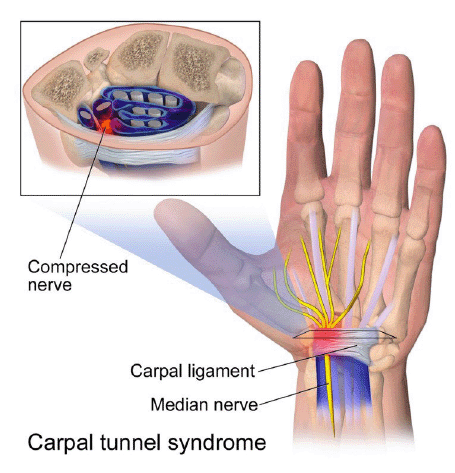
This image is available under the Creative Commons Attributions license and permits
use, distribution, and reproduction in any medium as long as attribution is provided.
To provide an adequate attribution, users must include the title of the work, the
author of the work, the source of the work, and the license of the original work [15].
The OER undergraduate pathophysiology textbook is still being written but so far,
the faculty author has been able to add six illustrations that were identified in
PubMed using the methodology above. As more chapters are authored, this number will
likely increase. There are still some diseases that need images that the authors haven’t
been able to locate in either PubMed or other OER image repositories.
DISCUSSION
This methodology can be reproduced by health sciences librarians at any institution
including academic campuses that are engaging in the creation of Open Educational
Resources projects such as textbooks, case studies, videos, or simulations, as well
as hospitals at which physicians are lecturing at society conferences and would like
to include copyright-safe images in their slides. Most health sciences librarians
use PubMed on a frequent basis and will be familiar with the recommended field tags.
Another benefit of finding images in this way is that librarians can discover repositories
and collections of openly licensed images of which they might not otherwise have been
aware. That was the case with the WikiJournal of Medicine, which the authors found
when searching for carpal tunnel syndrome images. This resource has now been used
and searched directly for other images for the textbook.
While this method can create many opportunities, there are also some limitations.
First, an article with an open license does not guarantee that the figures included
within are also openly licensed. Librarians need to provide some education to patrons
who are evaluating the figures regarding the complexity of article and image licensing.
This will help prevent a well-intentioned patron from using a copyrighted image by
accident. If librarians would like to learn more about copyright and how Creative
Commons licenses work, the content of the Creative Commons Certification Course is
freely available online [16].
It is also important to clearly delineate the role of the librarian. The nursing liaison
librarian did not assess the figures because she does not have that expertise. The
onus for determining the appropriateness and veracity of images must lie with the
faculty.
Another limitation is that most of the figures are in formats that are difficult to
edit. With many Creative Commons images, authors are legally allowed to make modifications,
such as moving the location of a caption or adding additional captions. This is more
difficult when the image is in a format such as a PDF, which may require additional
software and expertise which may not be accessible to everyone.
Finally, many of the figures are highly specific to the content of the article. There
are often case reports highlighting an unusual presentation of a disease state. Generally,
for a textbook, it is better to present undergraduate students with the typical or
expected version of a disease or condition. However, if the audience is clinicians
or residents, these specific images might be very helpful. This means that authors
may have more sifting to do to find the images that fit the needs of their audience.
If health sciences librarians keep these limitations in mind, this method of searching
PubMed is an easy way to help patrons find openly licensed images for their projects
without having to learn the quirks of a variety of OER repositories. It has been an
asset to the authors at the University of Colorado Anschutz Medical Campus and has
been replicated for other sections of the pathophysiology textbook.
As creation and implementation of OER grows in health sciences education, more faculty
will need to find openly licensed materials. Current mainstream methods and sources
of openly licensed medical images are inadequate and alternative methods are needed.
Searching PubMed with an OA filter is a creative approach to finding open-sourced
images that capitalizes on health sciences librarians existing skills and knowledge.
AUTHOR CONTRIBUTIONS
Ellie Svoboda: Conceptualization; methodology; investigation; resources; writing -
original draft; writing - review and editing. Teresa Connolly: Conceptualization;
methodology; investigation; resources; writing - original draft; writing - review
and editing.
DATA AVAILABILITY STATEMENT
There are no data associated with this article.
REFERENCES
1.
UNESCO. Recommendations on Open Educational Resources [Internet]. In: UNESCO. Paris, FR: UNESCO; 25 Nov 2019 [cited 8 Apr 2025]. https://www.unesco.org/en/legal-affairs/recommendation-open-educational-resources-oer?hub=785.
2. Hilton, J. Open educational resources, student efficacy, and user perceptions: a synthesis of
research published between 2015 and 2018. Educ Technol Res Dev. 2019 Aug;68(3):853–76. https://doi.org/10.1007/s11423-019-09700-4.
3. Colvard NB, Watson CE, Park H. The impact of open educational resources on various student success metrics. International Journal of Teaching and Learning in Higher Education. 2018 Jan;30(2):262–76.
4. Jenkins JJ, Sánchez LA, Schraedley MA, Hannans J, Navick N, Young, J. Textbook broke: Textbook affordability as a social justice issue. Journal of Interactive Media in Education. 2020;2020(1):3. http://doi.org/10.5334/jime.549.
5. Connolly T, Svoboda E. Open educational resources in nursing curricula: A systematic review. 2023 Mar;62(3): 147–154. doi: http://dx.doi.org/10.3928/01484834-20230109-04
 .
.
6. Luo T, Hostetler K, Freeman C, Stefaniak J. The power of open: benefits, barriers, and strategies for integration of open educational
resources. Open Learning: The Journal of Open, Distance and e-Learning. 2019;35(2):140–58. https://doi.org/10.1080/02680513.2019.1677222
7. Ghosh S. Evolution of illustrations in anatomy: a study from the classical period in Europe
to modern times. Anat Sci Educ. 2015 Mar-Apr;8(2):175–88. https://doi.org/10.1002/ase.1479.
8.
Public Health Image Library [Internet]. In: Centers for Disease Control and Prevention. [cited 21 May 2025]. https://phil.cdc.gov/default.aspx.
9.
Cell Image Library [Internet]. In: Cell Image Library. La Jolla, CA: Cell Image Library; [cited 21 May 2025]. https://www.cellimagelibrary.org/images/advanced_search.
10.
Open Access Biomedical Image Search Engine [Internet]. In National Library of Medicine. Bethesda, MD: National Library of Medicine; [cited 21 May 2025]. https://openi.nlm.nih.gov/.
11.
PMC User Guide. In National Library of Medicine. Bethesda, MD: National Library of Medicine; [cited 21 May 2025] https://pmc.ncbi.nlm.nih.gov/about/userguide/#bylicense.
12.
Creative Commons. About CC Licenses [Internet]. In: CreativeCommons. Mountain View, CA: Creative Commons; [cited 8 Apr 2025]. https://creativecommons.org/share-your-work/cclicenses/.
13.
Blausen.com staff: Medical gallery of Blausen Medical 2014. WikiJournal of Med. 2014, 1:http://dx.doi.org/10.15347/wjm/2014.010
.
14. Joshi A, Patel K, Mohamed A, Oak S, Zhang MH, Hsiung H, Zhang A, Patel UK. Carpal Tunnel Syndrome: Pathophysiology and Comprehensive Guidelines for Clinical
Evaluation and Treatment. Cureus. 2022 Jul 20;14(7):e27053. doi: http://dx.doi.org/10.7759/cureus.27053
.
15.
Use & Remix [Internet]. In: Creative Commons. Mountain View, CA: Creative Commons; [cited 21 May 2025]. https://creativecommons.org/share-your-work/use-remix/.
16.
Creative Commons Certificate for Educators, Academic Librarians, and Open Culture. In: Creative Commons. Mountain View, CA: Creative Commons; [cited 7 August 2025]. https://creativecommons.org/course/cc-cert-edu/.
Ellie Svoboda, MLIS, 1 ellie.svoboda@cuanschutz.edu, Strauss Health Sciences Library, University of Colorado Anschutz, Aurora, CO
Teresa Connolly, PhD, RN, ACNS-BC, 2 teresa.connolly@cuanschutz.edu, College of Nursing, University of Colorado Anschutz, Aurora, CO
© 2026 Ellie Svoboda; Teresa Connolly
This work is licensed under a Creative Commons Attribution 4.0 International License.
Journal of the Medical Library Association, VOLUME 114, NUMBER 2, April 2026
